The £1,000 trading allowance in 2025/26: claim it, or claim your expenses?
Updated 25 November 2026 · By CroftSheets (GPT Shop Ltd) · Figures checked against GOV.UK
The trading allowance lets you earn up to £1,000 a tax year from self-employment, side hustles or casual work without paying tax on it. Above that, you can use it instead of your expenses. Here's how to choose.
If your gross trading income is £1,000 or less
If your total trading income (before expenses) in the tax year is £1,000 or less, you usually don't need to register for Self Assessment or report it. "Gross" means the total you received, not your profit. There are exceptions, for example if you want to make a loss claim, or if you want to pay voluntary Class 2 NI to protect your State Pension record.
If it's more than £1,000
You must register and file a return, but you can choose between:
| Option | How it works | Example: £3,000 income, £400 expenses |
|---|---|---|
| A. Actual expenses | Taxable profit = income minus allowable expenses | £3,000 − £400 = £2,600 |
| B. Trading allowance | Taxable profit = income minus £1,000 (no other expenses) | £3,000 − £1,000 = £2,000 |
Pick whichever gives the lower profit. In the example, the allowance wins. If your expenses were £1,600, actual expenses would win (£1,400 profit). You can't claim both, and you can switch method each year.
Who can't use it
You can't use the trading allowance against income from a partnership you're a partner in, or income from a company you or someone connected with you controls (or your employer or your spouse's employer). Check GOV.UK if any of that applies.
Online sellers: selling your own stuff isn't trading
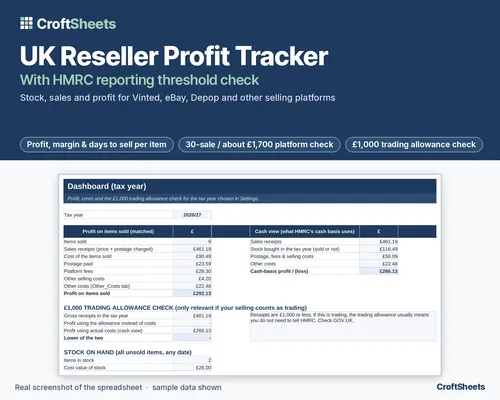
Clearing out your wardrobe on Vinted or eBay usually isn't trading, so it doesn't count towards the allowance. Buying items to resell at a profit, or making things to sell, usually is. See our guide to Vinted and eBay tax rules.
Where it goes on SA103S
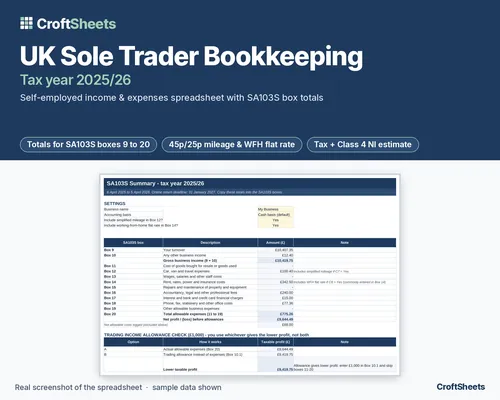
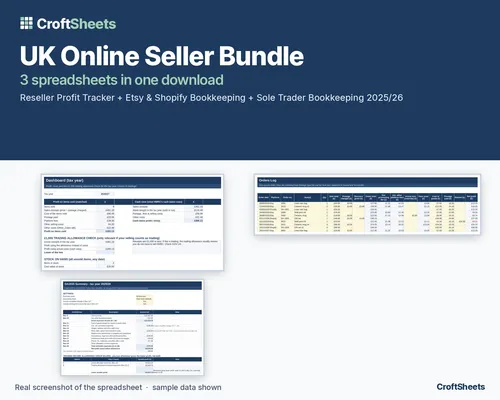
If you claim the allowance, enter it in box 10.1 and leave the expense boxes (11 to 19) blank. Our spreadsheets show both options side by side so you can see which gives the lower taxable profit.
Sole Trader Self Assessment Spreadsheet 2025/26: File your 2025/26 UK Self Assessment with less stress. Track income, SA103S expenses, mileage and WFH flat rates for 6 Apr 2025-5 Apr 2026 in Excel or Sheets.
See the spreadsheet (£12.99)