Self Assessment 2025/26 for sole traders: deadlines, rates and a checklist
Updated 25 November 2026 · By CroftSheets (GPT Shop Ltd) · Figures checked against GOV.UK
The 2025/26 tax year ran from 6 April 2025 to 5 April 2026. If you were self-employed during that time, your online Self Assessment return and any tax you owe are due by 31 January 2027. Here's what you need, in order.
Key dates for the 2025/26 return
| Date | What happens |
|---|---|
| 5 October 2026 | Deadline to register for Self Assessment if you started self-employment in 2025/26 and haven't filed before. |
| 31 October 2026 | Paper return deadline. |
| 31 January 2027 | Online return deadline, and the date to pay any tax owed for 2025/26 plus your first payment on account for 2026/27 (if one applies). |
| 31 July 2027 | Second payment on account for 2026/27 (if one applies). |
Miss the online deadline and HMRC charges a £100 penalty straight away, even if you owe no tax, with more after 3 months. Interest is charged on tax paid late.
Do you need to file?
You must file if you were self-employed as a sole trader and earned more than £1,000 (before expenses) from self-employment in the tax year, or if HMRC has sent you a notice to file. If your self-employed income was £1,000 or less, the £1,000 trading allowance may mean you don't need to report it.
Which self-employment pages: SA103S or SA103F?
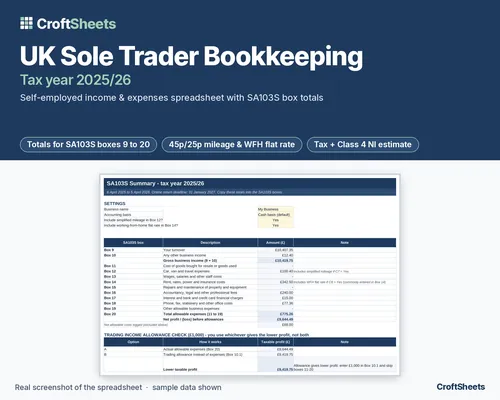
Most small sole traders use the short pages, SA103S, if their turnover was under £90,000. You fill in turnover in box 9, other business income in box 10, and allowable expenses in boxes 11 to 19, with the total in box 20. Online, HMRC asks the same questions in the same order. Our SA103S boxes guide explains each box.
2025/26 rates that affect your bill (England, Wales and NI)
| Item | 2025/26 |
|---|---|
| Personal Allowance | £12,570 (reduced by £1 for every £2 of income over £100,000) |
| Basic rate 20% | £12,571 to £50,270 |
| Higher rate 40% | £50,271 to £125,140 |
| Additional rate 45% | over £125,140 |
| Class 4 National Insurance | 6% on profits between £12,570 and £50,270; 2% above |
| Class 2 National Insurance | No longer compulsory. If profits are under £6,845 you can choose to pay voluntarily (£3.50 a week) to protect your State Pension record. |
Scotland has different income tax bands, so if you're a Scottish taxpayer, check the Scottish rates on GOV.UK.
Payments on account
If your 2025/26 bill is more than £1,000 and less than 80% of your tax was taken at source, HMRC will usually ask for two advance payments towards 2026/27, each half of this year's bill, on 31 January and 31 July 2027. This is why many people's first January bill is bigger than expected: it can be 150% of one year's tax. Set money aside monthly.
Checklist: what to gather before you file
- Your UTR (Unique Taxpayer Reference) and Government Gateway login
- All business income for 6 April 2025 to 5 April 2026 (invoices, platform payouts, card terminal reports)
- Allowable expenses sorted into the SA103S categories (boxes 11 to 19)
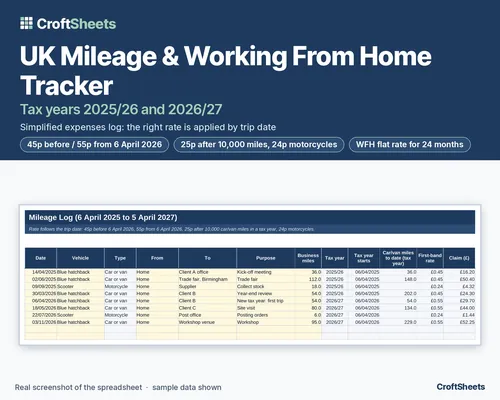
- Business mileage, if you use the simplified mileage rate (45p a mile in 2025/26)
- Hours worked at home each month, if you use the working-from-home flat rate
- Any employment income (P60), pension contributions, savings interest and Gift Aid donations
- Student loan plan, if you have one
Most sole traders now use the cash basis by default: you count money when it actually comes in and goes out. Keep records for at least 5 years after the 31 January deadline.
A spreadsheet that does the adding up
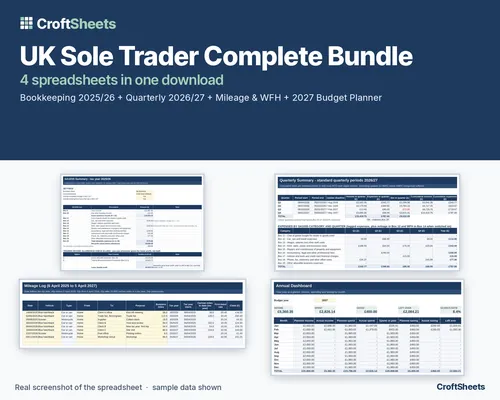
The CroftSheets 2025/26 spreadsheet has an income log and expense log with SA103S categories, a mileage and working-from-home tab, a £1,000 trading allowance check, and a rough tax and Class 4 NI estimate. It gives you the totals for boxes 9 to 20 to copy into your online return.
Sole Trader Self Assessment Spreadsheet 2025/26: File your 2025/26 UK Self Assessment with less stress. Track income, SA103S expenses, mileage and WFH flat rates for 6 Apr 2025-5 Apr 2026 in Excel or Sheets.
See the spreadsheet (£12.99)