Allowable expenses for the self-employed: the full UK list, by SA103S box
Updated 25 November 2026 · By CroftSheets (GPT Shop Ltd) · Figures checked against GOV.UK
Allowable expenses are business running costs you deduct from your income before tax. GOV.UK's example: turnover of £40,000 with £10,000 of allowable expenses means you pay Income Tax on £30,000 of profit. Here's what counts, sorted into the boxes on the short self-employment pages (SA103S).
| SA103S box | You can usually claim | You can't claim |
|---|---|---|
| 11: Cost of goods bought for resale or goods used | Stock, raw materials, direct costs of making goods | Goods for private use |
| 12: Car, van and travel expenses | Fuel, insurance, repairs, servicing, vehicle tax, parking, breakdown cover, train, bus, air and taxi fares, hotel rooms, meals on overnight business trips. Or use the mileage flat rate instead of actual vehicle costs | Travel between home and a regular workplace, non-business travel, fines and penalty charges |
| 13: Wages, salaries and other staff costs | Staff wages, bonuses, pensions, agency fees, subcontractors, employer's National Insurance, staff training | Your own drawings, carers or domestic help such as nannies |
| 14: Rent, rates, power and insurance costs | Rent and business rates for business premises, utility bills, property insurance, security, the business share of using your home (or the working-from-home flat rate) | The private share of home costs |
| 15: Repairs and maintenance of property and equipment | Repairs to business premises and equipment | Improvements and new equipment under traditional accounting (claim capital allowances) |
| 16: Accountancy, legal and other professional fees | Accountants, solicitors, surveyors and architects for business reasons, professional indemnity insurance | Legal costs of buying property and machinery, fines for breaking the law, the cost of preparing and submitting your Self Assessment return |
| 17: Interest and bank and credit card financial charges | Bank, overdraft and credit card charges, interest on business loans, hire purchase interest, leasing payments | Repayments of the loan itself |
| 18: Phone, fax, stationery and other office costs | Phone, mobile and internet bills (business share), postage, stationery, printing, ink, software used for under 2 years or on a subscription | Private use of phones and broadband |
| 19: Other allowable business expenses | Insurance such as public liability, advertising, website costs, trade journals, professional body membership, training that updates skills you already use, uniforms and protective clothing, promotional items with your logo (up to £50 per recipient per tax year) | Everyday clothing (even if worn for work), entertaining clients, gym membership, political donations, charity donations, training for a brand-new business |
Equipment: cash basis vs traditional
Items you keep and use in the business, such as a laptop or printer, are claimed as allowable expenses if you use the cash basis (most sole traders do), or as capital allowances under traditional accounting. Cars are different: under the cash basis, a car is still claimed through capital allowances, unless you use the mileage flat rate.
Mixed business and personal use
For phones, broadband, a car or your home, claim only the business share. Keep a simple note of how you worked it out (for example, a mileage log or a record of hours).
Proof
You don't send receipts with your return, but you must keep records that back up every figure in case HMRC asks. A spreadsheet with one row per expense and a category column makes the box totals automatic.
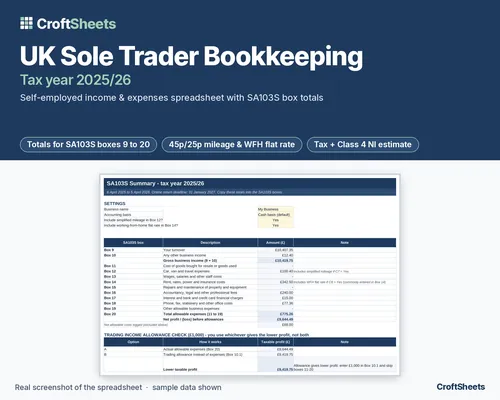
Sole Trader Self Assessment Spreadsheet 2025/26: File your 2025/26 UK Self Assessment with less stress. Track income, SA103S expenses, mileage and WFH flat rates for 6 Apr 2025-5 Apr 2026 in Excel or Sheets.
See the spreadsheet (£12.99)Sources
- GOV.UK: Expenses if you're self-employed
- GOV.UK: Simplified expenses if you're self-employed
- GOV.UK: SA103S short self-employment pages
Related guides
- Self Assessment 2025/26 for sole traders: deadlines, rates and a checklist
- SA103S boxes explained: the short self-employment pages for 2025/26
- Sole trader bookkeeping spreadsheet (UK): what to record and how to set it up
- HMRC mileage rates for the self-employed: 45p in 2025/26, 55p from 6 April 2026
- Working from home allowance for the self-employed: the £10, £18 and £26 flat rates
- The £1,000 trading allowance in 2025/26: claim it, or claim your expenses?
- Free self-employed tax calculator 2025/26