Making Tax Digital for Income Tax: who's affected, the £50,000 threshold and quarterly deadlines
Updated 25 November 2026 · By CroftSheets (GPT Shop Ltd) · Figures checked against GOV.UK
Making Tax Digital (MTD) for Income Tax is now live. Since 6 April 2026, sole traders and landlords above the first income threshold must keep digital records in HMRC-compatible software and send quarterly updates.
Who has to use it, and when
| If your qualifying income was over | In tax year | You must use MTD from |
|---|---|---|
| £50,000 | 2024/25 | 6 April 2026 (now) |
| £30,000 | 2025/26 (the return due 31 January 2027) | 6 April 2027 |
| £20,000 | 2026/27 | 6 April 2028 |
Qualifying income is your total self-employment and property income before expenses (turnover, not profit). So a sole trader with £32,000 of turnover and £12,000 of profit is over the £30,000 line. HMRC reviews each Self Assessment return and writes to people who need to join, but it's your responsibility to check even if no letter comes. Partnerships join later.
Why your 2025/26 return matters
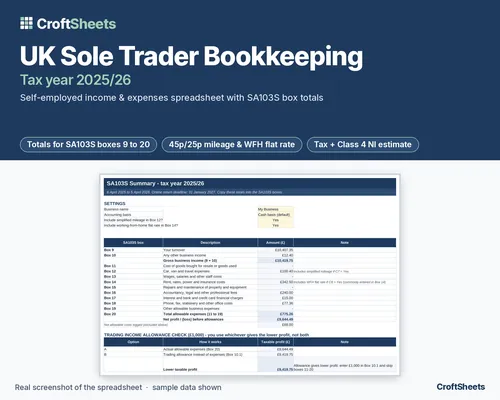
The figures on the return you're filing now, for 2025/26, decide whether you're in MTD from April 2027 (the £30,000 threshold). Get your turnover figure right and keep good records now.
Quarterly update deadlines
| Standard update period | Deadline |
|---|---|
| 6 April to 5 July | 7 August |
| 6 April to 5 October | 7 November |
| 6 April to 5 January | 7 February |
| 6 April to 5 April | 7 May (following tax year) |
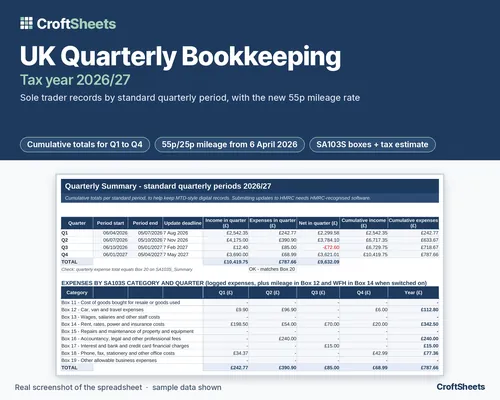
Each update is a cumulative summary of income and expenses by category, not a tax return. You still make a final declaration after the year ends. You must send an update even if there was no income in the period.
Penalties
HMRC won't apply penalty points for late quarterly updates during the 2026/27 tax year. After that, each late update earns a point, and reaching the points threshold means a £200 penalty.
Software and spreadsheets
MTD needs HMRC-compatible software. Spreadsheets can still be used for records if you pair them with bridging software that sends the updates. CroftSheets spreadsheets are record-keeping aids, not MTD software, and don't send anything to HMRC. If you're below the threshold, our quarterly 2026/27 workbook helps you keep records in the same quarterly shape, ready for when MTD reaches you. Some people may be exempt, for example if they're digitally excluded: check with HMRC's tool.
Quarterly Bookkeeping Spreadsheet 2026/27: Keep 2026/27 sole trader records (6 Apr 2026-5 Apr 2027) with totals for each standard quarter, SA103S categories and the new 55p mileage rate. Excel or Sheets.
See the spreadsheet (£13.99)Sources
- GOV.UK: Find out if and when you need to use Making Tax Digital for Income Tax
- GOV.UK: Send quarterly updates (Making Tax Digital for Income Tax)
Related guides
- Self Assessment 2025/26 for sole traders: deadlines, rates and a checklist
- SA103S boxes explained: the short self-employment pages for 2025/26
- Sole trader bookkeeping spreadsheet (UK): what to record and how to set it up
- HMRC mileage rates for the self-employed: 45p in 2025/26, 55p from 6 April 2026
- Working from home allowance for the self-employed: the £10, £18 and £26 flat rates
- The £1,000 trading allowance in 2025/26: claim it, or claim your expenses?
- Free self-employed tax calculator 2025/26