Payments on account explained: why your first January tax bill can be 150% of a year's tax
Updated 25 November 2026 · By CroftSheets (GPT Shop Ltd) · Figures checked against GOV.UK
Payments on account are advance payments towards next year's tax bill. They include Class 4 National Insurance if you're self-employed. They're the main reason a first-time sole trader's January bill is a shock.
Who has to make them
You must make 2 payments on account, each half of last year's tax bill, due by midnight on 31 January and 31 July, unless either:
- your Self Assessment tax bill was less than £1,000, or
- more than 80% of the tax you owed was already paid at source (for example through your tax code on a job).
First year: worked example
Using GOV.UK's example figures with the 2025/26 dates: your 2025/26 bill is £3,000 and you've never made payments on account.
| Due date | What you pay (first year, 2025/26 bill of £3,000) |
|---|---|
| 31 January 2027 | £3,000 for 2025/26 + £1,500 first payment on account for 2026/27 = £4,500 |
| 31 July 2027 | £1,500 second payment on account for 2026/27 |
| 31 January 2028 | Any balancing payment for 2026/27, plus the first payment on account for 2027/28 |
So you pay 150% of one year's tax in January. If your 2026/27 tax turns out higher than £3,000, you pay the difference as a balancing payment on 31 January 2028. If it's lower, you get money back or pay less.
Second year onwards
Each 31 January you pay the balancing payment for the year just ended plus the first payment on account for the current year. The balancing payment also includes anything owed for capital gains or student loan repayments.
Can you reduce them?
Yes. If you expect your profit to fall (for example, you stopped trading or had a quiet year), you can ask HMRC to reduce your payments on account, online or with form SA303. If you reduce them too far and end up owing more, HMRC charges interest on the shortfall, currently 8.00% a year (late payment interest from 24 November 2026: Bank of England base rate plus 4%).
How to budget for it
Put a fixed percentage of every payment you receive into a separate savings account. Our guide to how much to save for tax has worked percentages, and the free calculator shows your first-year January figure including the payment on account.
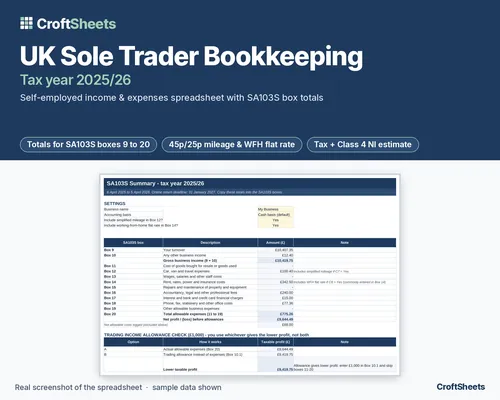
Sole Trader Self Assessment Spreadsheet 2025/26: File your 2025/26 UK Self Assessment with less stress. Track income, SA103S expenses, mileage and WFH flat rates for 6 Apr 2025-5 Apr 2026 in Excel or Sheets.
See the spreadsheet (£12.99)Sources
- GOV.UK: Payments on account
- GOV.UK: Pay your Self Assessment tax bill
- GOV.UK: HMRC interest rates for late and early payments
Related guides
- Self Assessment 2025/26 for sole traders: deadlines, rates and a checklist
- SA103S boxes explained: the short self-employment pages for 2025/26
- Sole trader bookkeeping spreadsheet (UK): what to record and how to set it up
- HMRC mileage rates for the self-employed: 45p in 2025/26, 55p from 6 April 2026
- Working from home allowance for the self-employed: the £10, £18 and £26 flat rates
- The £1,000 trading allowance in 2025/26: claim it, or claim your expenses?
- Free self-employed tax calculator 2025/26